
Shubhankar

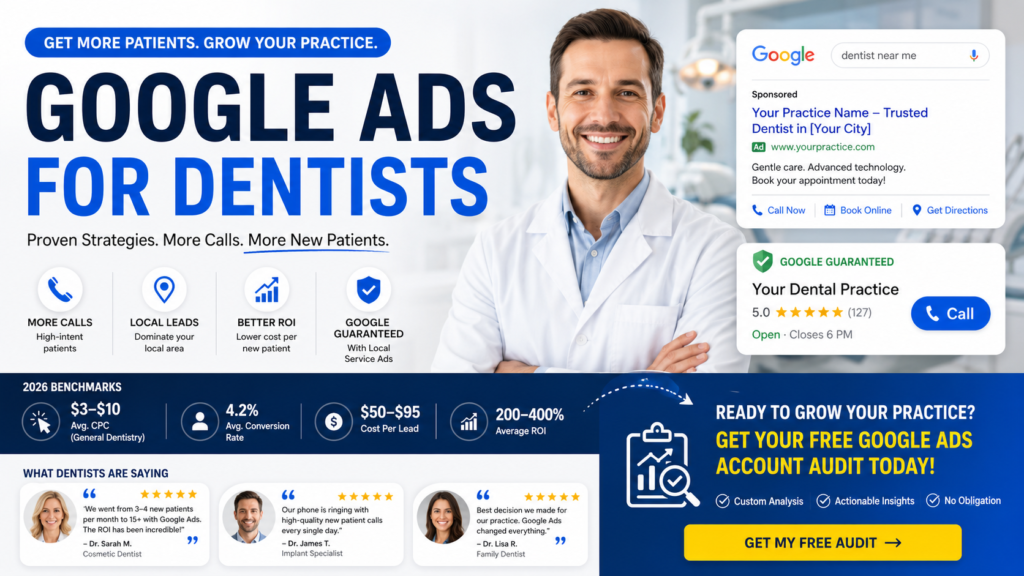
Google Ads for Dentists featured image showing a dentist, Google search ads, local service ads, patient acquisition metrics, ROI benchmarks, and a free Google Ads account audit call-to-action for dental practices

Google Ads for Dentists (2026): Get More Patients & Lower CPCs

Google Ads for Dentists in 2026: The Complete Guide to More Patients, Lower CPCs & Higher ROI Paid Ads Guide · Updated June 2026 Google Ads for Dentists: Stop Wasting Budget — Start Booking Patients The complete 2026 playbook for dental Google Ads — real benchmarks, proven campaign structures, and the exact mistakes costing practices thousands every month. SG Shubhankar Ghorai 18 min read June 6, 2026 200–400%ROI (optimized campaigns) $70–150Cost per new patient 4.2%Avg. conversion rate 70%+Searches on mobile $10K+Family patient lifetime value Table of Contents Do Google Ads Actually Work for Dentists? How Much Should You Spend? 2026 Cost & Performance Benchmarks Keyword Strategy: What to Target (and Avoid) Campaign Setup: Step-by-Step Ad Types for Dental Practices Real Case Studies 10 Costly Mistakes to Avoid Google Ads by Dental Specialty FAQs DIY vs. Hire an Agency Do Google Ads Actually Work for Dentists in 2026? Short answer: yes — when done correctly. Google Ads remains the fastest, most controllable patient acquisition channel available to dental practices. While SEO takes 3–6 months to build organic rankings, a well-structured Google Ads campaign can drive phone calls within the first 72 hours. The key word is correctly. Most dental practices that try Google Ads and walk away disappointed made the same predictable mistakes: sending traffic to the homepage, skipping negative keywords, not tracking conversions, or running ads around the clock when their front desk is closed. Fortunately, this guide addresses all of that — with actionable fixes for every scenario. The Patient Math A new general dentistry patient is worth $700–$1,500/year. A family is worth $10,000+ over time. An implant patient can represent $5,000–$30,000 in revenue. Even at $150 cost per acquisition, the return is extraordinary — 200–400% ROI on well-run campaigns. Google search is where patients go when they need a dentist right now. Someone typing “emergency dentist Austin” or “dental implants Houston” is not browsing — they’re ready to book. That intent is the foundation of why Google Ads works for dental practices at a level that social media advertising rarely matches for immediate patient conversion. Why Most Dental Campaigns Underperform The platform itself is not the problem. In most cases, poor results come down to a handful of structural issues: broad keywords burning budget on irrelevant searches, generic landing pages that don’t match the ad’s promise, and conversion tracking that was never set up in the first place. As a result, practices end up optimizing for clicks instead of actual booked appointments. Each of these issues is fixable — and fixing them is precisely what separates a 4% conversion rate from a 32% one. How Much Should a Dentist Spend on Google Ads? Budget is the most common question dentists ask about paid advertising — and, unsurprisingly, also the most common source of confusion. The right spend depends entirely on your market, the services you’re promoting, and your growth goals. Here’s the practical framework: Small / Rural $1,500–$2,500/mo Low competition markets. Ideal for general dentistry and emergency services. Suburban $2,000–$4,000/mo Most common practice type. Strong ROI for implants and Invisalign campaigns. Urban / Competitive $4,000–$8K+/mo NYC, LA, Houston, Austin. High CPCs demand larger budgets to stay competitive. Is $20 a Day Enough for Dental Google Ads? This is one of the most-searched questions about dental PPC — and the honest answer is no, not in most markets. At $20/day ($600/month) with an average CPC of $8–$12, you’re realistically looking at 50–75 clicks per month. That volume is barely enough to gather meaningful data, let alone build a consistent patient pipeline. In a very rural market with minimal competition, $20/day can serve as a proof-of-concept test for a single low-competition keyword. However, for any practice serious about patient acquisition, plan for at least $50–$100/day as a starting floor. Budget Allocation Strategy Start with your highest-value service. If you offer dental implants, for instance, allocate 60–70% of your initial budget there — the revenue per patient ($5K–$30K) far exceeds the cost per acquisition, making the ROI math undeniable. Once that campaign stabilizes, gradually expand to other services. 2026 Google Ads Cost & Performance Benchmarks for Dentists Cost per click in dental has risen significantly over the past two years. Consequently, understanding current benchmarks before setting a budget is essential. Here’s what to expect in 2026: Keyword Category CPC Range (2026) Conversion Rate Trend General Dentistry $3–$10 4–6% ↑ 10–15% YoY Competitive Markets (NYC, LA) $8.50–$15.75 3–5% Nearly doubled since 2023 Dental Implants $8–$25 (up to $50+) 5–8% ↑ from $8–$20 in 2024 Emergency Dental $6–$20 6–10% Best value category Invisalign / Orthodontics $5–$18 4–7% Strong intent Cosmetic / Veneers $6–$20 3–5% Growing demand Key Performance Metrics at a Glance Metric 2026 Benchmark Average conversion rate 4.2% (up from 3.8% in 2023) Cost per lead $50–$95 Cost per new patient (general) $70–$150 Cost per new patient (implants) $300+ ROI on well-optimized campaigns 200–400% Mobile search share 70%+ What These Numbers Mean in Practice Even at $150 cost per new patient for general dentistry, a family of four represents $10,000+ in lifetime value. For implant patients, that figure climbs to $20,000–$50,000. In other words, the economics of dental Google Ads are exceptionally strong — provided campaigns are tracked and optimized correctly. Keyword Strategy for Dental Google Ads Keyword selection is where most dental campaigns are won or lost before a single dollar is spent. The goal is to reach patients with high purchase intent — people who are actively searching for dental care, not researching dental schools, looking for free services, or shopping for a dental assistant job. High-Intent Keywords to Target Emergency intent: “emergency dentist [city],” “dentist open now,” “tooth pain relief near me” Local intent: “dentist near me,” “dentist in [neighborhood],” “family dentist [city]” Specialty intent: “dental implants [city],” “Invisalign [city],” “veneers dentist near me,” “cosmetic dentist [city]” Procedure intent: “teeth whitening near me,” “dental crowns near me,” “wisdom tooth removal [city]” Pro Tip: Neighborhood Over City Targeting “dentist in [neighborhood]” consistently outperforms “dentist [city]” in head-to-head tests. It’s

Google Ads for Dentists (2026): Get More Patients & Lower CPCs Read More »

Google Ads Campaign Types Explained: Which One is Right for Your Clients?

Google Ads Campaign Types Explained: Which One is Right for Your Clients? Understanding the 7 Types of Google Ads Campaigns Google Ads offers a variety of campaign types to help businesses reach their target audience effectively. In this guide, we’ll explore the different types of Google Ads with examples and help you determine which one is best for your clients. How Many Types of Google Ads Campaigns Are There? Google Ads provides 7 types of Google Ads campaigns, each designed for different marketing goals. These include: Exploring the Types of Google Ads with Examples 1. Search Ads – Capture High-Intent Customers Search campaigns place text-based ads on Google Search results when users look for relevant products or services. Example: A local bakery runs a Google Ads search campaign targeting keywords like “best cupcakes near me.” 2. Performance Max – AI-Powered Multi-Channel Advertising Performance Max campaigns help businesses reach their goals by using Google AI to optimize ads across all Google networks. Example: An e-commerce store uses Performance Max to showcase their products on Search, Display, YouTube, and Shopping. 3. Demand Gen – Drive Conversions with Engaging Ads Demand Gen campaigns use image and video ads to generate brand awareness and conversions. Example: A fashion brand launches a Demand Gen campaign on YouTube Ads and Google Discover Ads to promote a new clothing line. 4. Display Ads – Expand Reach with Visual Ads Display campaigns place image ads on millions of websites, apps, and YouTube to increase brand exposure. Example: A SaaS company runs a Display campaign with eye-catching banners to attract B2B customers. 5. Shopping Ads – Boost E-Commerce Sales Shopping campaigns help businesses sell products by displaying product listings in Google Search results. Example: An online electronics store runs a Google Shopping campaign to showcase their latest gadgets. 6. Video Ads – Engage Users on YouTube Video campaigns allow businesses to connect with audiences through skippable and non-skippable ads on YouTube. Example: A fitness brand creates a Video campaign to promote a new workout program with engaging content. 7. App Ads – Drive Installs and Engagement App campaigns promote mobile apps across Google Play, Search, YouTube, and Display. Example: A meditation app runs an App Install campaign to encourage downloads from potential users. How Many Campaign Types in Google Ads PDF? Marketers often ask, how many campaign types in Google Ads PDF documentation? Google officially supports these 7 types of Google Ads campaigns, with updates available in Google’s documentation. What Are the 3 Levels of Google Ads? Google Ads operates at three levels: How Many Types of PPC Campaigns Are There? Google Ads is a leading PPC (Pay-Per-Click) advertising platform, offering various campaign types, including Search, Shopping, Display, Video, Performance Max, Demand Gen, and App campaigns. Google Ads Format Size – Best Practices Each Google Ads format size varies by campaign type. Here are the most common ones: Conclusion Choosing the right types of Google Ads campaigns depends on your client’s goals. Whether they need search visibility, brand awareness, or e-commerce sales, Google Ads offers a solution for every business. Understanding these 7 types of Google Ads ensures your marketing strategy is optimized for success.

Google Ads Campaign Types Explained: Which One is Right for Your Clients? Read More »

google ads auction insights

How Google Ads Auction Works: Understanding the Auction System

How Google Ads Auction Works: Understanding the Auction System Introduction If you’re running Google Ads, understanding how Google Ads auction works is crucial to optimizing your campaigns and achieving better results. Google Ads operates through a competitive ad auction system, determining which ads appear for a given search query and in what order. In this guide, we will explore the mechanics of the Google Ads auction, how to interpret Google Ads Auction insights, and strategies to win the auction and maximize your ad performance. What is Google Ads Auction? The Google Ads auction is an automated system that determines which ads show up on Google Search, YouTube, and other Google networks. Each time a user performs a search, the auction takes place in milliseconds, selecting the most relevant ads based on various factors such as bids, ad quality, and expected impact. Ad Auction Meaning In simple terms, an ad auction is the process of ranking and displaying ads based on real-time competition among advertisers. It ensures users see the most relevant ads while maintaining fair competition among advertisers. How Google Ads Auction Works The Google auction operates on a pay-per-click (PPC) model, where advertisers bid for ad placements. The process includes the following key steps: How to Read Auction Insights in Google Ads Google provides Google Ads Auction insights, a valuable tool to analyze competitive performance. Here’s how to interpret it: By analyzing these metrics, advertisers can refine their strategies to improve ad performance. How to Win a Google Ads Auction Winning the Google ad auction requires more than just bidding high. Here are key strategies to maximize your chances of success: 1. Improve Your Ad Quality Score Google rewards advertisers with higher Quality Scores by prioritizing ads that are relevant and engaging. To enhance your Quality Score: 2. Optimize Your Bidding Strategy Google Ads bidding strategies determine how much you pay for each click. Consider the following: 3. Use Ad Extensions Google favors ads that provide additional useful information. Use site links, callouts, and structured snippets to increase your ad’s visibility and engagement. 4. Focus on High-Intent Keywords Instead of competing for broad, high-cost keywords, target long-tail keywords that indicate strong user intent. These often have lower competition and higher conversion rates. How Does Google Ads Bidding Work? Bidding in Google Ads is not just about who offers the most money. Instead, Google considers ad relevance, expected performance, and landing page experience to determine which ad ranks higher. Here’s how bidding works: For example, if your max CPC is $5 but the next highest bidder’s Ad Rank justifies a $3 bid, you might only pay $3.01 per click instead of the full $5. Google Ads Auction vs. Facebook Ad Auction The Ad auction Facebook operates is different from Google Ads. Here are some key differences: Conclusion Understanding how Google Ads auction works is essential for running successful PPC campaigns. By optimizing your Quality Score, bidding strategies, and ad relevance, you can improve your Google Ads Auction insights, lower costs, and increase ROI. Whether you’re a business owner or a digital marketer, mastering the Google Ads auction will help you maximize your advertising success. Start analyzing your ad auction insights today and refine your campaigns for better performance! References: Google Official Page

How Google Ads Auction Works: Understanding the Auction System Read More »

SEO vs PPC: Which is Best for Small Local Businesses?

For small local businesses, digital marketing can be a game-changer, but choosing between SEO (Search Engine Optimization) and PPC (Pay-Per-Click) can be overwhelming. Both strategies help drive traffic and generate leads, but they work differently. In this article, we’ll compare SEO and PPC to help you decide which is best for your business. What is SEO? SEO is the process of optimizing your website to rank higher on search engines like Google organically. It involves strategies like: Pros of SEO for Small Businesses: ✅ Cost-effective – No direct ad spend; long-term ROI.✅ Credibility & Trust – Higher organic rankings boost brand trust.✅ Sustainable Traffic – Continuous traffic without ongoing costs.✅ Better Local Visibility – Strong Google Business Profile rankings attract nearby customers. Cons of SEO: ❌ Takes Time – Results can take months to appear.❌ Requires Consistency – Needs ongoing content and optimization.❌ Algorithm Changes – Google updates can impact rankings. What is PPC? PPC is a paid advertising model where businesses bid for ad placements on search engines and social media platforms. Examples include: Pros of PPC for Small Businesses: ✅ Immediate Results – Traffic starts as soon as ads are live.✅ Targeted Audience – Reach people actively searching for your service.✅ Measurable ROI – Track performance through analytics.✅ Great for Local Reach – Google Local Service Ads attract ready-to-buy customers. Cons of PPC: ❌ Costs Can Add Up – High competition leads to expensive clicks.❌ Short-Term Visibility – Traffic stops when the budget runs out.❌ Requires Expertise – Needs campaign optimization to avoid wasted spend. SEO vs PPC: Which One Should Small Businesses Choose? ✅ Choose SEO if: ✅ Choose PPC if: 💡 Best Approach? A Mix of Both! A balanced strategy with SEO for long-term stability and PPC for quick wins is ideal. Use PPC to drive instant leads while SEO builds sustainable traffic. Final Thoughts For small local businesses, both SEO and PPC have their advantages. If you’re starting out and need immediate customers, PPC is the way to go. But for long-term success, SEO should be your priority. By combining both, you can maximize visibility, generate leads, and grow your business effectively. Need help setting up your SEO or PPC strategy? Let’s connect and create a tailored plan for your business success!

SEO vs PPC: Which is Best for Small Local Businesses? Read More »

5 Ways PPC Can Double Sales for E-Commerce Brands

Pay-per-click (PPC) advertising is one of the fastest ways to scale an e-commerce business. When done right, it can drive highly targeted traffic, increase conversions, and significantly boost revenue. But simply running ads isn’t enough—you need the right strategies to maximize returns. Here are five ways PPC can double sales for e-commerce brands. 1. Targeting High-Intent Keywords One of the most powerful aspects of PPC, especially on Google Ads, is the ability to target high-intent keywords. These are search terms that indicate a user is ready to make a purchase, such as: How It Works: Why It Works: High-intent keywords attract users who are already in the buying mindset, leading to higher conversion rates and more sales. 2. Retargeting for Abandoned Carts Nearly 70% of online shoppers abandon their carts before completing a purchase. PPC retargeting helps bring these lost customers back by displaying personalized ads across Google Display Network, Facebook, and Instagram. How It Works: Why It Works: Retargeting keeps your brand top-of-mind and reminds users to complete their purchase, significantly improving conversion rates. 3. Leveraging Google Shopping Ads Google Shopping Ads (Product Listing Ads) showcase product images, prices, and reviews directly on the search results page, making it easier for shoppers to make purchase decisions. How It Works: Why It Works: Shopping ads attract users with high purchase intent and provide essential details upfront, leading to higher click-through rates (CTR) and lower cost per acquisition (CPA). 4. Scaling with Social Media Ads (Facebook & Instagram) Social media platforms, particularly Facebook and Instagram, allow e-commerce brands to reach highly targeted audiences with visually engaging ads. How It Works: Why It Works: Social media ads create demand by reaching users who may not have been actively searching but are interested in your products. The ability to segment and personalize ad campaigns makes them incredibly effective for e-commerce brands. 5. A/B Testing & Continuous Optimization One of the biggest mistakes e-commerce brands make is running the same PPC campaigns without testing new strategies. A/B testing helps find winning ads that drive maximum sales. How It Works: Why It Works: Continuous testing and optimization ensure that you’re always improving your ad performance, lowering costs, and maximizing sales potential. Final Thoughts PPC advertising is a game-changer for e-commerce brands when executed strategically. By targeting high-intent keywords, using retargeting, leveraging Google Shopping Ads, scaling with social media, and continuously optimizing campaigns, e-commerce businesses can double (or even triple) their sales. Ready to take your PPC strategy to the next level? Let’s chat and optimize your ad campaigns for maximum ROI! 🚀

5 Ways PPC Can Double Sales for E-Commerce Brands Read More »